Here is a video-clip of an unusual sheep movement near Llanarmon Dyffryn Ceiriog, North Wales.
I have titled it as a round-up but can't see any evidence of farmers or dogs on the scene. Maybe something just spooked the flock and off they went.
Sheep farminghas been important to the Welsh economy. Sheep farms are most often situated in the country's mountains and moorlands, where sheepdogs are employed to round up flocks. Sheep are also reared, however, along the south and west coasts of Wales.There are currerntly about 10 million sheep in Wales and the total flock made up nearly 33% of the British total.In 2011 sheep farming accounted for 20% of agriculture in Wales.Historically sheep were raised for their wool but today lamb meat is the key product.
Loch Ness from flight of locks at Fort Augustus, Scottish Highlands This evening, I am posting information on Fort Augustus, a busy tourist village on the southern tip of Loch Ness in the Scottish Highlands. Summary information on Fort Augustus as follows:- Population about 650 persons. Distance, about 160 miles from Edinburgh and 35 miles from Inverness entailing journey times of 3.5 hours and 1 hour respectively. Well endowed with hotels and other accommodation plus shops, restaurants and visitor attractions. From here visitors can avail of boat trips on Loch Ness. Home to an impressive flight of five locks on the Caledonian Canal. Latter dates from 1822 and is now primarily used by pleasure boats. Closely linked with the 18th century Jacobite uprising in that (a) the village was renamed Fort Augustus (after Prince William Augustus, third son of King George II) consequent upon construction of a British military (redcoat) fort in 1742 and (b) the same Pri...
Introduction This afternoon, I am reporting on a five mile hike along the Forth & Clyde Canal.This route followed the Canal from Clydebank to Maryhill, Glasgow . Busker at Clydebank Background information on the canal The Forth & Clyde Canal was completed in 1790, linking the east and west coasts of Scotland between Grangemouth and Bowling covering a distance of 35 miles.This was during the early industrial period when roads were poor and railways had yet to dominate the transport scene. For part of it’s route, the canal follows the line of the 2nd century AD Antonine Wall built by the Romans. Along the canal are 39 locks and the 123m long, Kelvin Aqueduct. The canal originally served the iron, chemical, timber, boat building and coal industries. The canal was closed to navigation in 1963 but re-opened in 2001. It is now principally a leisure resource. Kelvin Aqueduct Sights and Sites Along the way I was fortunate to e...
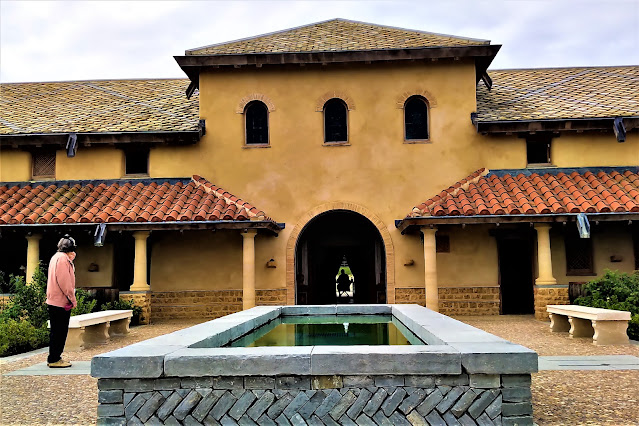
This evening, I am reporting on my visit earlier today to a meticulously reconstructed Roman Villa in Somerset, England. Funding for the project was provided by a South African billionaire. Specific features of the reconstruction project which is known as 'Villa Ventorum': Employed hundreds of architects, builders, archaelogists, mosaic makers, fresco painters and experts on ancient plumbing. The new build was built close to the remains of the original villa which dates from AD351. Incorporates the only working hypocaust system in Europe to create authentic Roman underfloor heating. Thne system also provides heating for the internal baths. Designed to appear to visitors as though still in use. Mosaics and frescoes have been made below the top standards of the time (e.g. Chedworth ) to reflect the social rank of the resident family. Incorporates a Roman 'fast food bar' along the lines of that found in Pompeii . (Core of above information sourced from the Times newspape...


Comments
Post a Comment