Bayeaux Tapestry
Introduction
I have just returned from a 650 mile round trip to view the famous Bayeaux Tapestry a facsimile of which being on display at Tewkesbury Abbey in the English Cotswolds.In fact the tapestry is an embroidery but in this report I will use the description of tapestry as this is in common use.
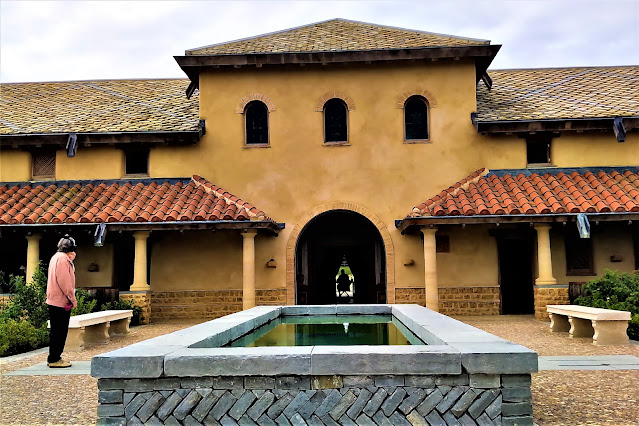
Tewkesbury Abbey

Information on the Bayeaux Tapestry
The cloth comprising the tapestry is nearly 70 metres (230 feet) long and 50 cm (20 inches) tall. It depicts the events leading up to the Norman conquest of England led by William, Duke of Normandy (France) and the transforming Battle of Hastings in 1066.
Due to the length of the tapestry the presentation of it has been split into two sections-hence two videos below.
Basically, the underlying story of the tapestry centres on a dispute over succession of the English monarchy. The kingship should have passed to William of Normandy on death of Edward the Confessor but Harold reneged on his oath of allegiance to William and assumes role of King of England. This act resulted in a military invasion of England by William which entailed the death of Harold and the resultant introduction Norman rule.
Existence of the tapestry was first recorded (in Bayeaux Cathedral, France) in 1476. However, it is believed to have been embroidered by nuns in Canterbury, England some time following the Battle of Hastings but exact dates and timings are not known, neither is the connection with Bayeaux.
The tapestry does not seem to have been produced as a triumphal record of the Norman military success at Hastings.It features ships crossing the Channel,armies on the move, construction of castles, feasting hunting scenes,sea transport, ceremonies and acts of faith.The tapestry also features curious creatures including what appears to be camels.Overall, an excellent insight into the life and times of the period.
Effect on Language
Over the period from the commencement of Saxon rule through to the English civil war there may have been at least 50 major battles on English soil. On this basis the conflict at Hastings is just another conflict.However, Hastings was a seminal event on a world scale.After the conflict England was basically trilingual: Norman French was used for government and administration,Latin was the language of the church and Judiciary whilst the common people continued to speak Old English (Anglo-Saxon). Old English proved remarkably adept at absorbing new words and concepts whereas French and Latin have proved much less flexible.Hence English is the dynamic language we have today, dominating business and the World Wide Web.
During Norman times some 10,000 French words were adopted into English. Some estimates state that over 40,000 English words today come directly from French.
When the Normans invaded the population of England was likely no more than 5 million whereas today, around the world, there are about 400 million native English speakers and around 1.1 billion second language speakers.
Video 1
Video 2
Still images from section of tapestry comprising video 1.


Here is famous depicture of King Harold with death caused by an arrow in his eye. This scene features in video 2.

Here is a link to information on the English Cotswolds and Shakespeare country.


Comments
Post a Comment